CS2 Trade-Up Calculator: Odds, Float and Profit Explained
How to price any contract before you risk a single skin
By chod on August 31, 2026
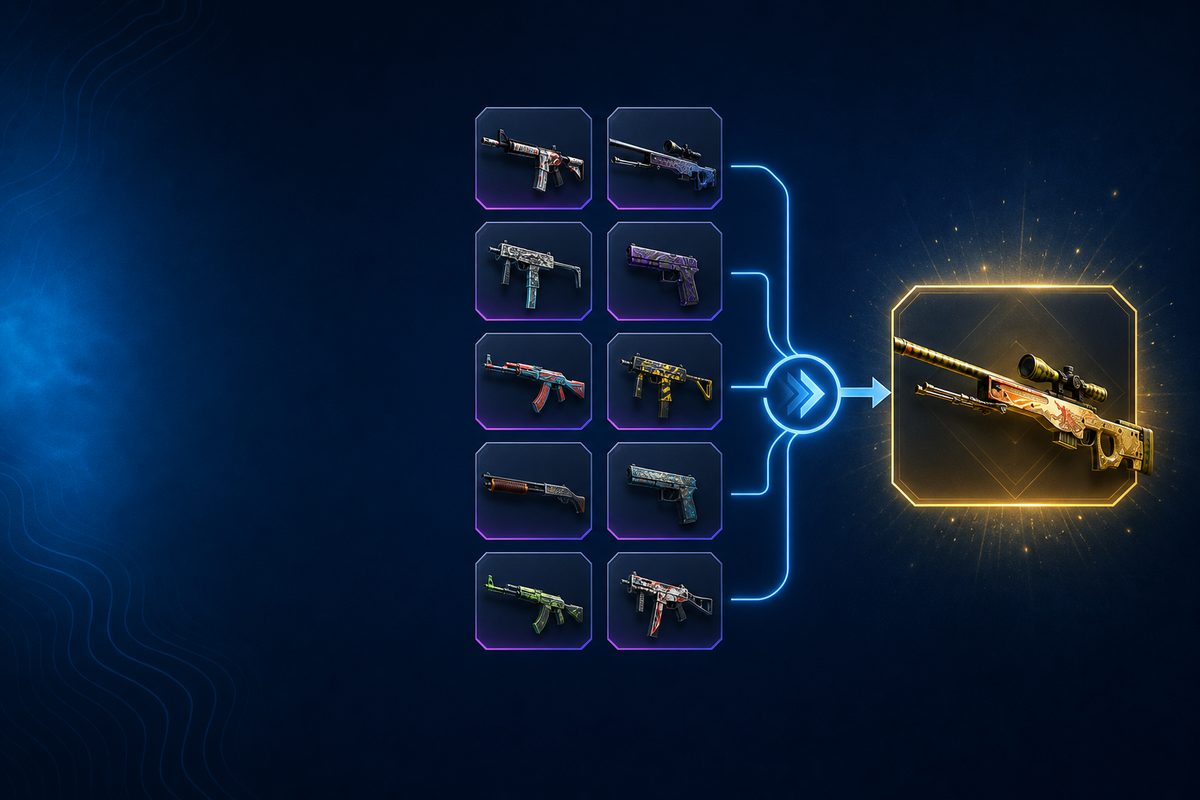
A CS2 trade-up calculator answers one question: is this contract worth running? It takes your ten input skins, works out every possible output and how likely each one is, predicts the float you will get, prices it all against the live market, and tells you whether the expected value beats what you paid.
Open the Trade Up Lab calculator
»
Free, no account needed, live prices from the CS2 market.
What a trade-up calculator works out for you
- Every possible outcome — the calculator resolves which collections your inputs belong to and lists every skin one rarity higher that you could receive.
- The odds of each one — each collection's share of the odds equals its share of your ten inputs, divided evenly across that collection's outputs.
- The output float — your inputs' floats are normalised, averaged and mapped into the output skin's own float range, which decides the wear you receive.
- Expected value — every outcome multiplied by its probability, priced at the wear you are predicted to get.
- Odds to profit — the chance the skin you actually receive is worth more than the contract cost. This is the number people skip, and the one that decides whether you can survive a losing streak.
How to use it, step by step
- Add your ten input skins. Search by name; the calculator loads the collection, rarity and live price automatically.
- Set the float for each input. This is the single biggest lever you control, so use the real floats of the copies you intend to buy.
- Override prices if you found a better deal. If you can buy an input below market, enter your actual cost so the profit figure is honest.
- Read the outcome table. You want the high-probability outcomes to be the valuable ones, not just one expensive long shot.
- Compare expected value to total cost. Positive means profitable on average. Then check odds to profit to understand the variance you are signing up for.
- Buy and execute. Source inputs on Tradeit.gg or CSFloat, then run the contract in game.
The maths behind the calculator
Nothing here is hidden. Each input is normalised inside its own float range:
normalised = (input float − skin min float) ÷ (skin max float − skin min float)
Those are averaged across all ten inputs and mapped into the output's range:
output float = average × output float range + output min float
And the odds for any individual outcome are:
P(outcome) = (inputs from its collection ÷ 10) ÷ (outputs in that collection)
Skip the setup
If you would rather not build contracts from scratch, our live trade-ups page runs this calculation continuously across the whole market and publishes the contracts that come out profitable. Every one of them opens in the calculator with the inputs already filled in.
Frequently asked questions
Is the CS2 trade-up calculator free?
Yes. The Trade Up Lab calculator is free and needs no account or Steam login. It uses live market prices and shows the full outcome table, float prediction and profit maths.
How accurate is a trade-up calculator?
The odds and float calculations are exact — they follow Valve's formulas precisely. The profit figure is only as accurate as the price data behind it, and skin prices move constantly, so treat expected value as a snapshot rather than a guarantee.
How do you calculate CS2 trade-up odds?
Count how many of your ten inputs come from each collection. That collection's share of the odds equals that fraction, split evenly across every skin it has at the output rarity. Six inputs from a collection with three possible outputs gives each of those three a 20% chance.
What is expected value in a trade-up?
The average result if you ran the same contract many times: each possible output multiplied by its probability, added together. If that total is higher than what you spent on inputs, the contract is profitable on average.
Does the calculator handle StatTrak trade-ups?
Yes. StatTrak inputs must all be StatTrak and produce a StatTrak output; the calculator enforces that and prices the StatTrak versions of every outcome.
Can I calculate a knife trade-up?
Yes. Five Covert skins from collections that contain knives or gloves produce a Gold-tier item, and the calculator switches to the five-input rule automatically when you add Coverts.
Keep reading
- CS2 trade-ups under $5
- Best CS2 trade-ups under $10
- 100% profit CS2 trade-ups
- CS2 trade-ups with 10% profit
- Best low float CS2 trade-ups
- CS2 restricted trade-ups
- CS2 trade-up calculator: float
- Live profitable trade-ups
- Open the calculator
Ready to find your next profitable trade-up?
Trade Up Lab tracks profitable CS2 trade-up contracts in real time, with live prices, float calculations and profit odds worked out for you.
Disclaimer: Trade-up contracts involve risk and prices move quickly. Figures in this article reflect market data at the time of writing and are not financial advice. Always double-check prices before committing skins. Some links are affiliate links that support Trade Up Lab at no extra cost to you.
